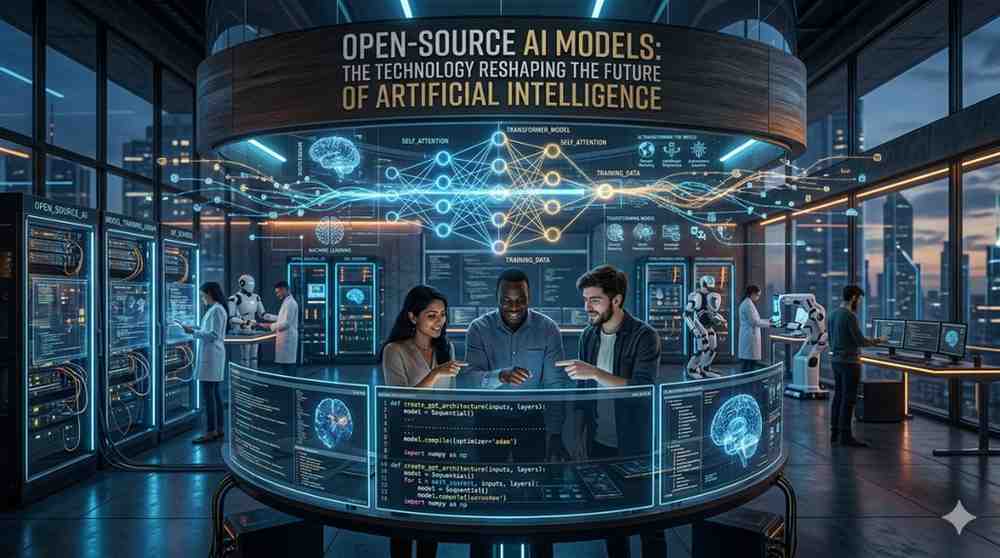
Open-Source AI Models: The Technology Reshaping the Future of Artificial Intelligence
Lisa Park • October 27, 2026
Artificial intelligence is no longer confined to giant technology corporations and elite research laboratories. In recent years, open-source AI models have transformed the technological landscape, making powerful machine learning tools accessible to developers, startups, researchers, students, and independent creators across the globe.
What was once exclusive infrastructure controlled by a handful of organizations is rapidly becoming democratized. Today, anyone with sufficient computing resources can download, fine-tune, modify, and deploy advanced AI systems capable of generating text, images, music, code, video, and scientific insights.
Open-source AI models are fueling innovation at an unprecedented scale. They are accelerating research, disrupting industries, empowering communities, and challenging traditional ideas about ownership, transparency, and technological control.
But open-source AI is also controversial. Questions about safety, ethics, misuse, copyright, regulation, and economic disruption have become central to public debate. To understand why open-source AI matters so deeply, we must explore its origins, evolution, benefits, risks, and future.
What Are Open-Source AI Models?
An open-source AI model is an artificial intelligence system whose underlying code, architecture, weights, or training methods are publicly available for use, modification, and redistribution.
Unlike proprietary AI systems controlled entirely by private companies such as :contentReference[oaicite:0]{index=0}, open-source models allow developers to:
- Inspect how the model works
- Customize behavior
- Fine-tune for specific tasks
- Build commercial products
- Conduct independent research
- Improve transparency
Open-source AI promotes collaborative innovation rather than centralized control.
The Origins of Open-Source Software Culture
The open-source movement grew from earlier software philosophies emphasizing transparency and collaboration. Projects like :contentReference[oaicite:1]{index=1}, :contentReference[oaicite:2]{index=2}, and :contentReference[oaicite:3]{index=3} demonstrated that global communities could build powerful systems collectively.
This philosophy later influenced artificial intelligence research communities.
The Rise of Modern AI Models
The AI revolution accelerated with deep learning breakthroughs and transformer architectures, adopted widely across systems developed by companies like :contentReference[oaicite:4]{index=4} and :contentReference[oaicite:5]{index=5}.
Key milestones included large language models, GPU acceleration, and massive datasets, while proprietary systems remained dominant due to cost and safety concerns.
Breakthrough Open-Source AI Models
LLaMA Series
The :contentReference[oaicite:6]{index=6} models significantly boosted open-weight AI adoption, enabling developers to build chatbots, research tools, and local AI systems.
Mistral AI Models
:contentReference[oaicite:7]{index=7} introduced efficient models that demonstrated strong performance with fewer parameters.
Stable Diffusion
:contentReference[oaicite:8]{index=8}, developed with contributions from :contentReference[oaicite:9]{index=9}, revolutionized image generation and creative industries.
EleutherAI
:contentReference[oaicite:10]{index=10} proved that decentralized communities could replicate large-scale AI research efforts.
How Open-Source AI Models Work
Modern AI systems are trained using vast datasets and computational resources, often shared and studied through platforms like :contentReference[oaicite:11]{index=11} and collaborative code repositories such as :contentReference[oaicite:12]{index=12}.
The process includes data collection, training neural networks, optimizing parameters, and fine-tuning outputs for deployment.
Advantages of Open-Source AI
- Democratization: Access for global developers regardless of organization
- Transparency: Ability to inspect model behavior
- Faster Innovation: Global collaboration accelerates progress
- Customization: Adaptation for specialized industries
- Privacy: Local deployment without data sharing
Challenges and Risks
- Misinformation and deepfakes
- Cybersecurity exploitation
- Bias in training data
- High hardware requirements
Open-Source vs Proprietary AI
Proprietary systems like those developed by :contentReference[oaicite:13]{index=13} or :contentReference[oaicite:14]{index=14} offer controlled environments, while open-source models prioritize transparency and flexibility.
The Role of Communities
Communities on platforms like :contentReference[oaicite:15]{index=15} and :contentReference[oaicite:16]{index=16} contribute to model improvement, benchmarks, and safety tools.
The Future of Open-Source AI
The future likely includes hybrid ecosystems where open-source and proprietary models coexist. Trends point toward smaller efficient models, stronger regulation, and broader accessibility.
Conclusion
Open-source AI represents a major shift in technological power distribution. It enables global participation in artificial intelligence development while raising important questions about safety, ethics, and governance.
As systems evolve, open-source communities will remain central to innovation, shaping how intelligence technologies are built, shared, and controlled in the decades ahead.