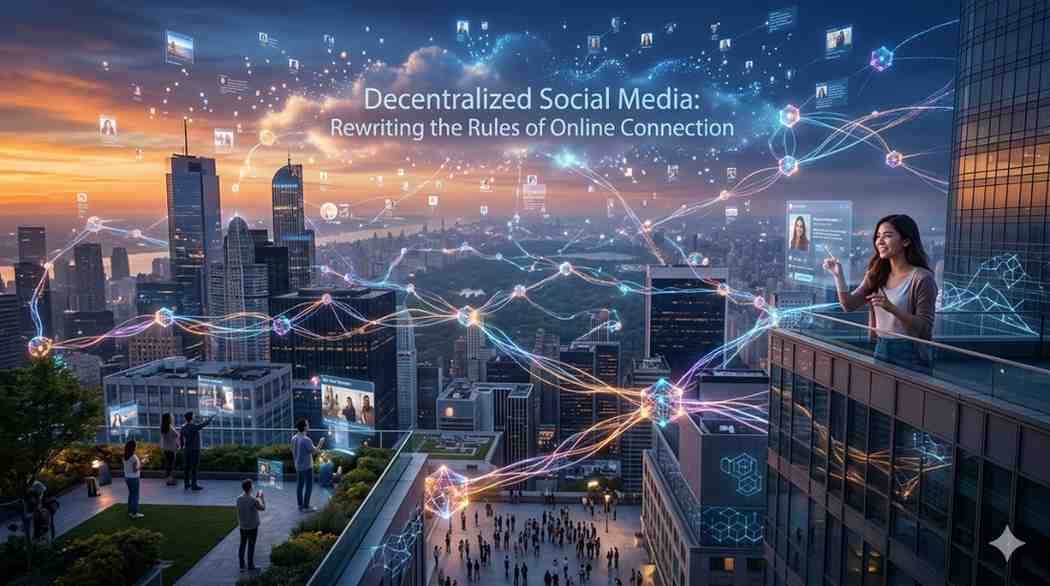
Decentralized Social Media: Rewriting the Rules of Online Connection
Lisa Park • October 27, 2026
For most of the internet’s modern history, social media has been dominated by a handful of centralized platforms. These companies decide what users see, how content spreads, what gets removed, and even how communities are shaped. While this model created global communication at unprecedented scale, it also introduced problems: algorithmic manipulation, data privacy concerns, censorship debates, and monopolistic control over digital discourse.
In response, a different vision has been gaining momentum — decentralized social media. Instead of one company controlling everything, decentralized networks distribute control across many independent servers, communities, or even users themselves.
This shift is not just technical. It is philosophical. It asks a fundamental question: what if social media didn’t belong to companies at all?
What Is Decentralized Social Media?
Decentralized social media refers to online platforms where:
- No single company owns the entire network
- Data is distributed across independent servers
- Users can move between platforms without losing identity or followers
- Communities can set their own moderation rules
Unlike traditional platforms such as Facebook or Instagram, decentralized systems avoid centralized control points by using many interconnected nodes or instances.
The Problem with Centralized Social Media
1. Algorithmic Control
Platforms like :contentReference[oaicite:0]{index=0} and Facebook rely on algorithms that shape what users see, often prioritizing engagement over accuracy.
2. Data Ownership
In centralized systems, user data is stored and monetized by companies, limiting user control over personal information.
3. Censorship and Moderation Power
Platforms can remove content, ban accounts, or enforce global policies, leading to debates about transparency and fairness.
4. Platform Dependency
Creators are vulnerable to sudden policy changes, algorithm shifts, or account bans that can disrupt entire livelihoods.
The Rise of Decentralized Networks
Decentralized social media is built on open protocols such as ActivityPub, developed under the :contentReference[oaicite:1]{index=1}. These protocols enable the creation of the “fediverse,” a network of interconnected platforms.
The Fediverse: A Network of Networks
The fediverse is made up of independent servers that communicate with each other while maintaining their own rules and communities. Users can interact across platforms seamlessly.
Mastodon: The Open Twitter Alternative
:contentReference[oaicite:2]{index=2} is one of the most widely used decentralized social platforms.
It allows users to join independent servers, each with its own moderation policies, while still connecting to the wider network.
Bluesky and the AT Protocol
:contentReference[oaicite:3]{index=3} is another major initiative exploring decentralized social networking through the AT Protocol, focusing on portable identity and algorithmic choice.
How Decentralized Social Media Works
1. Federation
Independent servers communicate using shared protocols, each managing its own users and rules.
2. Interoperability
Different apps can interact across the same network, allowing cross-platform communication.
3. Data Portability
Users can move accounts between servers while retaining followers and content.
Centralized vs Decentralized Social Media
Centralized:
- One company controls everything
- Unified database
- Algorithm-driven feeds
Decentralized:
- Many independent servers
- Community-driven moderation
- Open protocols
Benefits of Decentralized Social Media
- User control: More ownership over identity and data
- Reduced monopoly power: No single dominant corporation
- Custom communities: Servers define their own culture
- Transparency: Open systems can be inspected
- Algorithm choice: Users can select or design feeds
Challenges of Decentralized Social Media
- Complex onboarding and usability issues
- Inconsistent moderation across servers
- Scalability challenges
- Less polished user experience
- Strong network effects favoring big platforms
The Role of Open Source
Most decentralized platforms are built on open-source collaboration, with development happening through communities on platforms like :contentReference[oaicite:4]{index=4}.
Content Moderation Challenges
Moderation in decentralized systems varies by server and may include community rules, shared blocklists, and AI-assisted filtering tools.
Privacy and Security Advantages
Decentralized systems reduce centralized data collection, allowing users to choose trusted servers and limit corporate tracking.
The Future of Decentralized Social Media
Future development is likely to focus on improved usability, unified protocols, cross-platform identity systems, and hybrid models combining decentralization with convenience.
Will It Replace Big Tech Platforms?
It is unlikely that decentralized networks will fully replace platforms like Facebook or Instagram, but they may strongly influence how social media evolves.
Conclusion
Decentralized social media represents a shift toward treating online platforms as shared infrastructure rather than corporate products. It offers greater user control, transparency, and innovation, but also faces real challenges in moderation, usability, and scale.
Ultimately, it reflects a broader question about the future of the internet: who should control the spaces where global communication happens — companies, or the communities themselves?